- 1. The Multi-Agent Landscape: Role-Playing vs Directed Graphs
- 2. LangGraph Deep Dive: State, Reducers & Cyclic Transitions
- 3. The Hierarchical Supervisor Pattern in Python
- 4. Production Persistence: Time-Travel & Checkpointers
- 5. Human-in-the-Loop Validation & Breakpoints
- 6. Token Economics & Cost Governance across Swarms
- 7. Frequently Asked Questions
1. The Multi-Agent Landscape: Role-Playing vs Directed Graphs
In early 2024, multi-agent frameworks generated intense excitement by demonstrating autonomous problem-solving through simulated persona interactions. However, early production deployments revealed a harsh reality: unconstrained agent conversations frequently degenerated into sycophantic infinite loops, hallucinated consensus, and runaway token bills.
Today, the enterprise landscape has converged on two mature, yet fundamentally different architectural paradigms:
- CrewAI (Role-Playing Swarms): Models software engineering as a human organization. Agents are defined by roles, goals, backstories, and assigned toolkits. While intuitive and fast to bootstrap, strict determinism and dynamic error recovery require extensive guardrail configuration.
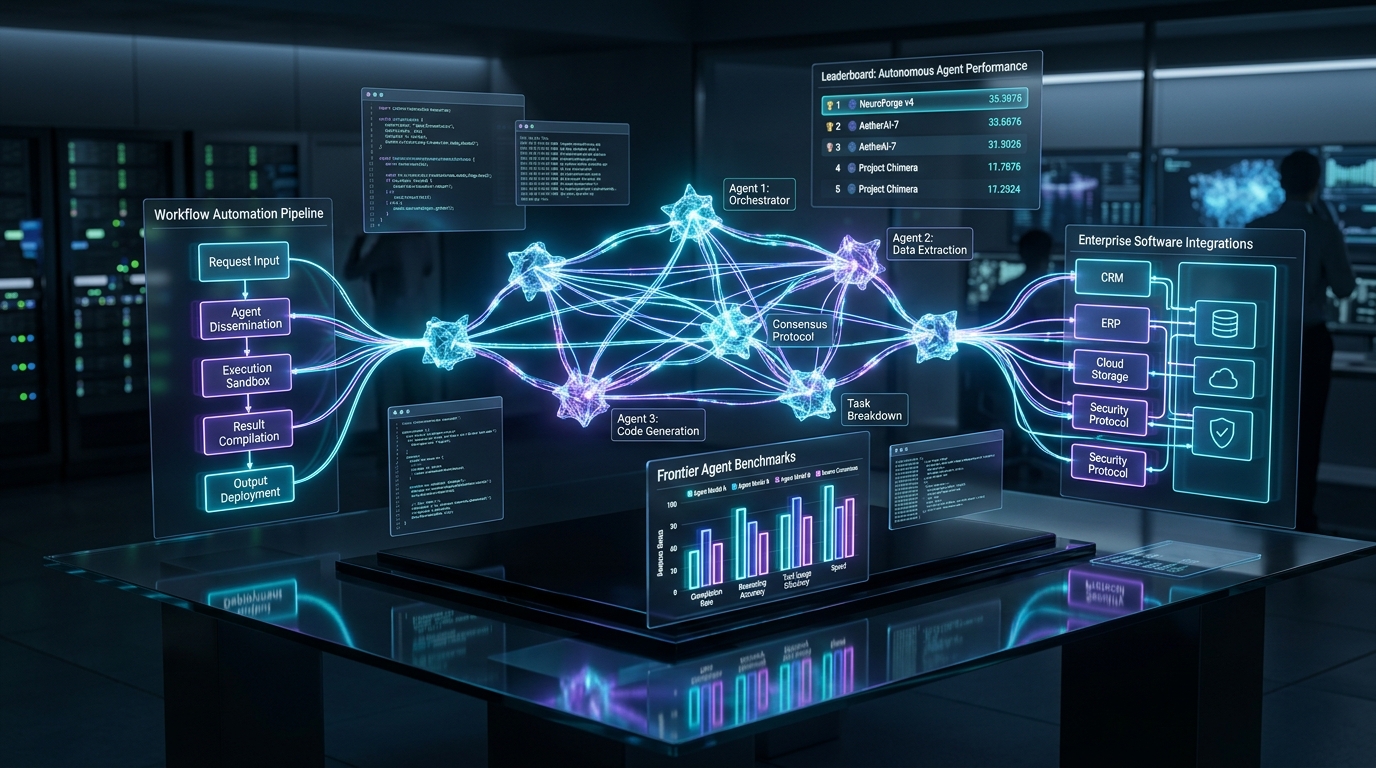
- LangGraph (State Machine Graphs): Treats multi-agent workflows as stateful computation graphs. Nodes represent agents or tool invocations, edges represent conditional branching logic, and state is preserved across a strongly typed schema. Cycles, parallel fan-outs, and rollbacks are first-class primitives.
For a historical perspective on autonomous digital entities and virtual environments, explore our foundational piece on Autonomous AI Agents in Enterprise Workflows.
2. LangGraph Deep Dive: State, Reducers & Cyclic Transitions
In LangGraph, all agents operate on a shared, immutable state representation. Changes to state are governed by reducer functions:
from typing import Annotated, Sequence, TypedDict
from langchain_core.messages import BaseMessage
import operator

class AgentState(TypedDict):
    # Operator.add ensures messages are appended to history, not overwritten
    messages: Annotated[Sequence[BaseMessage], operator.add]
    current_step: int
    assigned_worker: str
    code_diff: str
    unit_tests_passing: bool
    requires_human_approval: bool
This architecture ensures that agent decisions are strictly decoupled from memory mutations, making every execution trajectory reproducible, debuggable, and auditable.
3. The Hierarchical Supervisor Pattern in Python
The most robust multi-agent architecture for enterprise code generation is the Supervisor Pattern. A primary orchestrator model assigns discrete tasks to specialized worker nodes (e.g. CodeWriter, TestRunner, SecurityAuditor) and verifies outcomes before transitioning state:
from langgraph.graph import StateGraph, END
from langchain_anthropic import ChatAnthropic

# Initialize supervisor LLM with structured output schema
llm = ChatAnthropic(model="claude-3-5-sonnet-20241022", temperature=0)

def supervisor_node(state: AgentState):
    messages = state["messages"]
    # Instruct supervisor to select next worker or conclude
    system_prompt = (
        "You are an engineering supervisor managing: CodeWriter, TestRunner, SecurityAuditor. "
        "Review current conversation and determine who acts next. If finished, reply FINISH."
    )
    decision = llm.invoke([{"role": "system", "content": system_prompt}] + messages)
    return {{"assigned_worker": decision.content}}

def route_worker(state: AgentState):
    worker = state["assigned_worker"]
    if "FINISH" in worker:
        return END
    return worker

# Construct graph
workflow = StateGraph(AgentState)
workflow.add_node("supervisor", supervisor_node)
workflow.add_node("CodeWriter", code_writer_node)
workflow.add_node("TestRunner", test_runner_node)

workflow.set_entry_point("supervisor")
workflow.add_conditional_edges("supervisor", route_worker)
workflow.add_edge("CodeWriter", "supervisor")
workflow.add_edge("TestRunner", "supervisor")

app = workflow.compile()
4. Production Persistence: Time-Travel & Checkpointers
In production environments, network failures, database disconnects, or API rate limits will inevitably disrupt multi-agent runs. Without persistence, a crash after 15 minutes of compute forces the entire workflow to restart from scratch.
LangGraph solves this through Checkpointers (e.g., PostgresSaver or MemorySaver). At every edge transition, the entire AgentState snapshot is serialized to persistent storage. This unlocks "Time-Travel Debugging" — engineers can inspect past execution states, edit an agent's erroneous assumption at Step 4, and re-execute forward without re-running Steps 1 through 3.
5. Human-in-the-Loop Validation & Breakpoints
Autonomous agents should never execute high-consequence operations (such as deploying code to production or deleting cloud resources) without explicit human confirmation.
By setting interrupt_before=["DeployNode"], LangGraph halts graph execution and pauses state. The system emits a webhook to an administrative dashboard. Only when a human operator reviews the proposed diff and clicks "Approve" does the graph resume execution.
6. Token Economics & Cost Governance across Swarms
A single complex multi-agent execution involving 4 agents across 8 iterative rounds can easily consume over 500,000 tokens. To maintain economic viability:
- Leverage Prompt Caching: Ensure your framework places static system prompts and repository file listings at the head of messages to trigger the 90% read cache discount in Claude 3.5/3.7 and Gemini.
- Model Cascades: Do not use flagship reasoning models like OpenAI o1 or Claude 3.7 for every micro-task. Route simple unit-test parsing to distilled open-weights models like DeepSeek-V3 or local Ollama instances, reserving high-cost models for the supervisor node.
Calculate your monthly team expenditures across different agent swarm architectures using our Frontier API Pricing & Token Cost Estimator.
7. Frequently Asked Questions
Can I mix different LLM providers inside a single LangGraph workflow?
Yes. LangGraph is provider-agnostic. You can assign Claude 3.7 Sonnet as the code architect, DeepSeek-R1 as the mathematical verification agent, and a local Ollama instance for formatting and JSON parsing.
How does LangGraph scale to hundreds of concurrent agent workflows?
By using LangGraph Server or containerized asynchronous task queues (such as Celery or Temporal), each agent workflow executes as an independent stateless worker task, storing checkpoint state in a shared PostgreSQL database.